
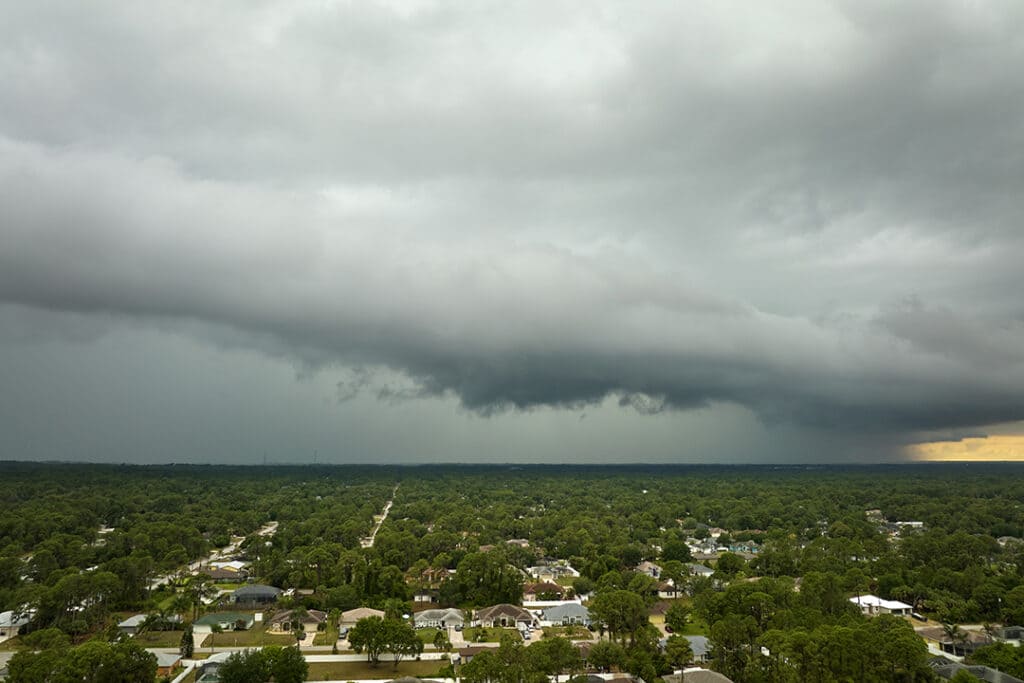
Hurricane Beryl made landfall as a Category 1 storm in July 2024 and left more than 2.2 million homes and businesses across the Houston area without power. Temperatures topped 100°F. Critical systems went dark. Some facilities were offline for days. The scale of disruption was not the result of a catastrophic storm. It was the result of a grid pushed past its limits by a storm that, by historical standards, was relatively modest. That reality, reinforced again by the 2025 season’s four major hurricanes, has reshaped how Houston enterprises think about industrial generator rentals and what constitutes an acceptable power continuity plan as the 2026 season approaches.
Houston’s location along the Gulf Coast makes it one of the most storm-exposed major business markets in the country. Petrochemical facilities, hospitals, data centers, cold storage warehouses, and manufacturing plants cannot afford extended outages. For many of these operations, the financial and operational consequences of even a few hours without power reach well into six figures. The question most businesses face is not whether they need an industrial emergency power strategy. It is whether the one they have is ready before the next storm makes that question urgent.
How Houston’s Storm History Shapes Business Power Decisions
The 2024 hurricane season delivered a pointed lesson through Hurricane Beryl and a May derecho that struck in rapid succession. After Beryl made landfall in July 2024, CenterPoint Energy acknowledged that distribution infrastructure had not kept pace with the transmission system, leaving commercial customers across Harris County without power for days. The city of Houston subsequently received a $314.6 million federal recovery grant to address resilience gaps. The 2025 season brought further pressure, producing 13 named storms, 5 minor hurricanes, and 4 major hurricanes, including Category 5 Hurricane Melissa. Each successive Hurricane season has reinforced the same message: the grid alone is not a reliable power continuity strategy along the Gulf Coast.
That infrastructure gap matters directly for businesses. Most commercial properties are connected to standard distribution lines, which are disproportionately at risk during storm events when compared to the high-voltage transmission system that serves large industrial customers. The National Hurricane Center defines June 1 through November 30 as the official Atlantic hurricane season, a six-month window during which Gulf Coast enterprises must treat power continuity as an active operational concern, not a contingency.
CSU’s April 2026 forecast projects 13 named storms, 6 minor hurricanes, and 2 major hurricanes for the 2026 season, slightly below long-term averages, primarily because a moderate to strong El Niño is expected to develop and dominate the August through October peak window. The IRI Columbia February 2026 ENSO outlook confirms this trajectory: La Niña conditions have been declining since mid-February 2026, with ENSO-neutral currently dominant and El Niño probabilities rising sharply to 58 to 61 percent from May through the end of 2026. While El Niño typically suppresses Atlantic storm formation through elevated wind shear, it does not eliminate landfall risk. The 2023 season, which was also influenced by El Niño, showed that warm Atlantic sea surface temperatures can partially offset that suppression. CSU still places the probability of a major hurricane striking the Gulf Coast at 20 percent for 2026. For Houston, even a single significant storm remains a serious operational threat.
Why Grid Dependency Alone Puts Operations at Risk
Businesses that wait until a storm enters the Gulf often find rental inventory depleted and delivery times extended. The window between a Gulf storm alert and landfall is typically 48 to 72 hours. That is not enough time to source, transport, connect, and test an industrial generator at most commercial sites. By the time a business realizes it needs emergency power, the supply chain has already been claimed by operators who planned their strategy months in advance.
Beyond storm-season logistics, the grid itself presents structural risks that extend year-round. Federal emergency preparedness guidance consistently identifies power disruption as the single most common cause of business interruption events, and Houston’s proximity to the Gulf Coast amplifies that exposure significantly. Industrial facilities along the Houston Ship Channel, petrochemical refineries in Freeport conducting planned maintenance turnarounds, and healthcare networks managing patient care through grid fluctuations all operate with a risk profile that standard utility reliability cannot fully address.
Diesel generators remain the preferred choice when grid reliability is uncertain, particularly in high-demand commercial and industrial environments. Their fuel stability, load capacity, and durability under sustained operation make them well-suited to the prolonged outage scenarios that Gulf Coast storms regularly produce.
The Role of Standby Diesel Generator Rentals in Storm Season
A standby diesel generator rental offers a different kind of value from an outright purchase, especially for businesses that face predictable seasonal risk rather than year-round dependency. The capital cost of purchasing a 500kW diesel generator can range from $150,000 to $300,000. Rental arrangements allow that same capacity to be accessed at a fraction of that investment, deployed before the season starts, and returned when the threat window closes.
Rental programs also shift the burden of maintenance, compliance, and equipment readiness to the rental provider. A generator that has not been load-tested before a storm is not a backup system. It is an untested asset that may or may not perform under load. Reputable rental providers deliver equipment that has been serviced, tested, and confirmed operational before it reaches the site.
The practical advantage of renting over purchasing becomes even clearer when businesses consider the full picture: fuel management, automatic transfer switch integration, cable distribution, and 24/7 technical support are often bundled into rental agreements. That support infrastructure matters enormously when a storm hits at 2 a.m. and operations cannot wait for a service call.
Sizing Industrial Emergency Power to Match Operations
One of the most common failures in business power planning is under-sizing the generator relative to actual operational load. A facility may know its peak kilowatt demand under normal conditions but fail to account for motor start-up surges, HVAC cycling, and the simultaneous load draw that occurs when power is restored after an outage.
Right-sizing an industrial generator rental requires a load analysis that captures both running watts and starting watts for each critical system. The table below outlines common Houston commercial and industrial use cases with typical generator size ranges.
| Facility Type | Critical Systems | Typical Generator Range |
|---|---|---|
| Hospital or Healthcare Facility | Life support, surgical suites, HVAC, medication refrigeration | 800 kW to 2,000 kW |
| Data Center | Servers, cooling systems, UPS integration, communications | 500 kW to 2,000 kW |
| Warehouse or Manufacturing Plant | Production lines, HVAC, lighting, refrigeration | 200 kW to 1,000 kW |
| Water Treatment Facility | Pumping systems, treatment controls, and monitoring equipment | 300 kW to 1,500 kW |
| Petrochemical or Refinery Site | Process controls, safety systems, and emergency lighting | 500 kW to 2,000 kW |
| Commercial Office Building | Elevators, HVAC, lighting, server room, communications | 100 kW to 500 kW |
Generator sizing should also account for redundancy. N+1 redundancy, where one additional generator beyond the minimum required load is held in reserve, is widely recommended for mission-critical operations. This ensures that if a single unit requires maintenance or encounters a fault during a storm event, operations are not interrupted.
Building a Contingency Power Plan Before Storm Season Opens
A contingency power plan is more than a list of backup equipment. It defines how power will be sourced, connected, tested, fueled, and managed across each phase of a storm event, from pre-storm preparation through post-storm recovery. Businesses that treat this as a document-filing exercise rather than an operational protocol tend to find gaps when the plan is actually needed.
Hurricane contingency generator rental plans typically include several components that go beyond simply reserving a unit. Generator placement must account for flood elevation, exhaust direction, fuel delivery access, and cable routing to the primary electrical panel. Transfer switch configuration must be reviewed to confirm that the generator will connect to the intended loads and that manual overrides are understood by on-site staff.
Harris County backup generator requirements also impose specific compliance considerations, particularly for healthcare facilities, water utilities, and other regulated operations. These requirements cover placement setbacks, exhaust emissions, noise ordinances, and fuel storage. Businesses operating under these regulations should factor compliance review into their pre-season planning timeline. Houston’s federally funded resilience investments following the 2024 disasters underscore that the city’s power protection standard is rising, and that expectation now extends to commercial operators as well.
The ideal planning window opens in February or March, well before the June 1 season start. Generator inventory gets reserved, transfer switch compatibility is confirmed, fuel supplier agreements are established, and load testing is completed with enough lead time to address any issues before they matter.
For facilities that need power after a storm has already hit, an emergency industrial generator rental is available for same-day deployment across Greater Houston and the Gulf Coast.
Power Planning Mistakes Houston Businesses Repeat Every Season
Several patterns emerge consistently among businesses that find themselves underprepared when a storm arrives. Recognizing them in advance is the most effective way to avoid them.
- Waiting until a storm watch is issued. At that point, available rental inventory across the Houston market is largely committed. Businesses that call for a generator after a storm enters the Gulf are frequently told delivery cannot be guaranteed before landfall.
- Skipping load testing before deployment. A generator that passes a visual inspection may still fail under the actual load demands of a live facility. Load testing confirms that the unit performs reliably at the required capacity before it is called upon during a real event.
- Underestimating fuel requirements. During extended outages, fuel delivery logistics become strained. A generator running continuously at 75 percent load consumes significantly more fuel per hour than businesses typically budget for. Fuel planning should extend to at least 72 hours of continuous operation, with a supplier agreement in place for replenishment.
- Neglecting pre-season maintenance. Generator maintenance before hurricane season is the most cost-effective investment a business can make in its power continuity plan. Coolant levels, battery condition, belt integrity, and control panel diagnostics should all be confirmed before the season begins.
- Operating generators without proper ventilation. NFPA 110 Standards have established industry and safety requirements that address adequate exhaust clearance and airflow around operating units. Enclosed spaces without proper ventilation create carbon monoxide risks and cause generator thermal management issues that can shorten run time or trigger safety shutdowns at the worst possible moment.
- Not accounting for extreme heat conditions. Post-storm Houston environments often combine high ambient temperatures with high humidity, both of which reduce the thermal efficiency of diesel generators. Operating industrial generators under extreme heat conditions requires specific attention to cooling system capacity, airflow, and load management.
Stag Power Rentals Keeps Houston Operations Running Through the Storm
At Stag Power Rentals, we work with Houston enterprises before storm season opens, not after it strikes. Our team handles site assessment, generator sizing, transfer switch compatibility, fuel planning, and 24/7 technical support so operations stay online when the grid goes down.
We provide industrial diesel generator rentals from 20 kW to 2,000 kW, with same-day delivery across Greater Houston, Pasadena, Baytown, Pearland, Sugar Land, Texas City, Galveston, and surrounding Gulf Coast communities. Our fleet is maintained, tested, and ready before a storm watch is ever issued.
Contact us before storm season hits. We can help with your:
- Pre-season generator reservation to lock in availability before inventory is committed
- Site-specific load analysis to confirm the right generator size and configuration
- Full transfer switch integration and cable distribution setup
- Fuel supply coordination and on-site fueling support during extended events
- 24/7 technical support throughout the rental period
Don’t wait until the Gulf lights up on the forecast map. Explore our hurricane contingency power plans or request a quote today to get power continuity locked in before the season demands it.
