
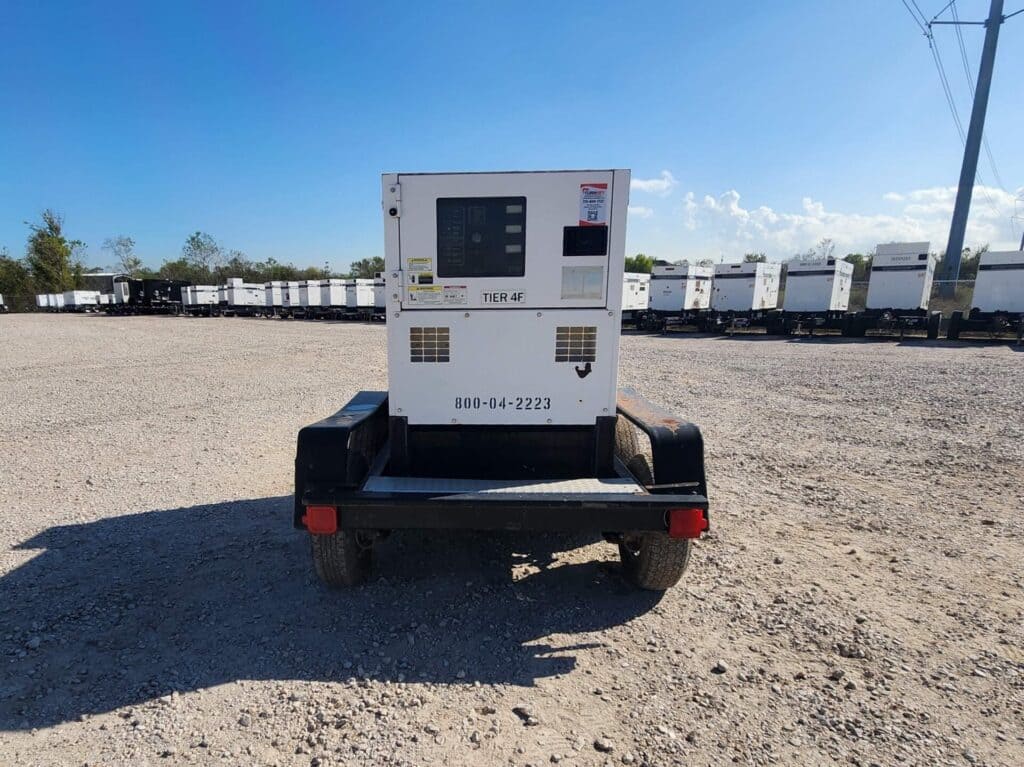
Houston has one of the most complex power environments of any major American city. It sits in a region where hurricanes, tropical storms, extreme heat, and unexpected equipment failures can pull the grid down with little warning. When Hurricane Beryl swept through Southeast Texas in July 2024, more than 2.6 million customers lost power, and many commercial and industrial operations went dark for days.
That event was not an anomaly. It was a reminder of what Houston businesses already know: grid reliability cannot be counted on when conditions turn severe. For operations where every hour offline translates directly into lost revenue, spoiled inventory, idle labor, or regulatory liability, waiting on utility restoration is not a viable strategy. Rapid emergency diesel generator delivery is how businesses stay operational when the grid cannot.
Why Houston’s Power Grid Creates Ongoing Risk
Houston’s position as the energy capital of the world does not insulate it from grid vulnerability. The city’s power infrastructure is managed primarily by CenterPoint Energy, a distribution network that serves millions of customers across a metropolitan area constantly exposed to Gulf Coast weather systems. The Public Utility Commission of Texas adopted a Value of Lost Load figure of $35,685 per megawatt-hour to quantify what outages actually cost consumers statewide. For commercial and industrial facilities drawing significant load, even a brief interruption compounds quickly into five- and six-figure losses.
Beyond weather events, planned maintenance shutdowns, transformer failures, and grid congestion from rapid industrial growth all contribute to power interruptions that are difficult to predict and impossible to schedule around. Manufacturing plants, refineries, data centers, healthcare facilities, logistics hubs, and retail operations throughout Houston face the same calculation: how fast can backup power be deployed, and what does delay cost?
What Downtime Actually Costs a Commercial Operation
The financial impact of power loss is not limited to lost sales. It is a cascading event that touches every layer of an operation simultaneously. A 2024 hourly cost of downtime analysis found that 97% of large enterprises report a single hour of downtime costs more than $100,000, with 41% citing costs between $1 million and $5 million per hour, depending on the industry vertical. For smaller commercial operations, the proportional impact relative to revenue is often even more severe.
Houston’s industrial base amplifies these figures. Refineries and petrochemical facilities face process interruptions that require costly restart sequences. Cold chain operations in food distribution and healthcare logistics risk spoilage the moment refrigeration units go offline. Manufacturing floors with automated systems lose not just productivity but also the time required to re-establish process conditions after power is restored. The damage extends well beyond the outage window itself.
How Emergency Diesel Generator Delivery Works
Emergency diesel generator delivery is a structured, time-sensitive process that gets a fully fueled and operational power unit on-site and connected before losses compound. The sequence involves load assessment, unit selection, transport, connection through a transfer switch or distribution panel, and commissioning. When a rental provider operates locally with a standing fleet and experienced field technicians, the time from call to power restoration can be dramatically compressed.
The key variables that determine deployment speed are fleet availability, proximity to the site, and the technical readiness of the crew. A provider without local stock will need to source and transport equipment from out of market, adding hours to a situation where hours are the currency of loss. Diesel generators in the 20 kW to 2,000 kW range cover the load requirements of virtually every commercial and industrial use case, from a single critical circuit to a full facility backup configuration. Matching the correct unit to the site’s demand profile is part of what a qualified rental provider handles during the initial assessment.
Planned Outages Require the Same Speed
Not every generator rental engagement is a crisis response. Scheduled maintenance, utility infrastructure upgrades, transformer replacements, and electrical system work all require a site to take a planned outage. For a commercial facility, even a planned outage carries real cost if operations cannot continue through it. Fast generator rental makes it possible to maintain production schedules, keep climate-sensitive inventory protected, and meet contractual obligations to clients even while permanent electrical systems are offline.
Planned rental engagements also allow for more thorough load analysis and connection planning. Transfer switches, cable runs, and distribution panels can be staged in advance. The generator is already on-site and commissioned before the planned shutdown begins, which means zero gap in operational power. This level of preparation is standard practice among industrial facilities that have learned to treat temporary power as a project requirement rather than a contingency.
Matching Generator Size to Business Load Requirements
One of the most common mistakes in commercial backup power planning is sizing the generator to the wrong load. An undersized unit will fail to carry the full site demand, forcing operators to shed load from non-critical systems or risk damaging the generator itself. An oversized unit wastes fuel and increases rental costs unnecessarily. Proper sizing requires a load calculation that accounts for starting current requirements, simultaneous load, and any sensitive equipment that requires clean, stable power.
| Operation Type | Typical Load Range | Common Power Requirement |
|---|---|---|
| Small commercial office or retail | Low | 20 kW to 100 kW |
| Mid-size warehouse or logistics facility | Moderate | 100 kW to 350 kW |
| Large industrial plant or refinery support | High | 500 kW to 2,000 kW |
| Data center or critical infrastructure | Variable, mission-critical | 250 kW to 1,000+ kW |
The NFPA 110 standard for emergency and standby power systems provides guidance on performance requirements and testing protocols for backup power installations, which informs how rental configurations should be set up at regulated facilities such as healthcare and public safety sites. A qualified rental provider will be familiar with these requirements and can configure equipment accordingly.
Renting vs. Owning Commercial Backup Power
For many Houston businesses, permanent generator ownership involves capital expenditure, ongoing maintenance obligations, fuel management, load bank testing schedules, and long-term storage considerations. These costs are manageable for facilities where backup power is a daily operational requirement. For businesses that face intermittent outage risk, seasonal weather exposure, or temporary project needs, rental delivers the same level of protection without the asset burden.
Flexible billing structures, such as single shift, double shift, and round-the-clock options, allow commercial and industrial clients to pay for the coverage their operation actually requires rather than maintaining a depreciating asset that sits unused most of the year. When an emergency outage occurs, the rental relationship is already established, which accelerates response time and eliminates the administrative friction of sourcing a new vendor under pressure.
Stag Power Rentals Keeps Houston Operations Running
When power fails or a planned outage approaches, Houston commercial and industrial operations need a local partner with fleet availability, technical expertise, and the logistics capability to deploy fast. Stag Power Rentals provides emergency power solutions and generator rentals across the Houston area, sized from 20 kW to 2,000 kW, backed by flexible shift-based billing and full accessory support, including cables, transfer switches, distribution panels, and spider boxes.
- Emergency diesel generator rental support for unplanned outages, grid failures, and commercial downtime risk
- Planned outage power support for maintenance, upgrades, and infrastructure work
- Commercial backup power rental with single, double, and triple shift billing options
- Full power distribution accessories, including transformers, Iline panels, and cable runs
- Fleet coverage from small commercial loads to large-scale industrial requirements
Do not wait until the next outage to establish a power continuity plan. Many of the Houston businesses we have supported through past outages have shared their experience in our customer reviews, and we welcome the same feedback from every client we serve. Contact us today to discuss load requirements, available units, and deployment timelines that keep operations moving no matter what the grid does.
