
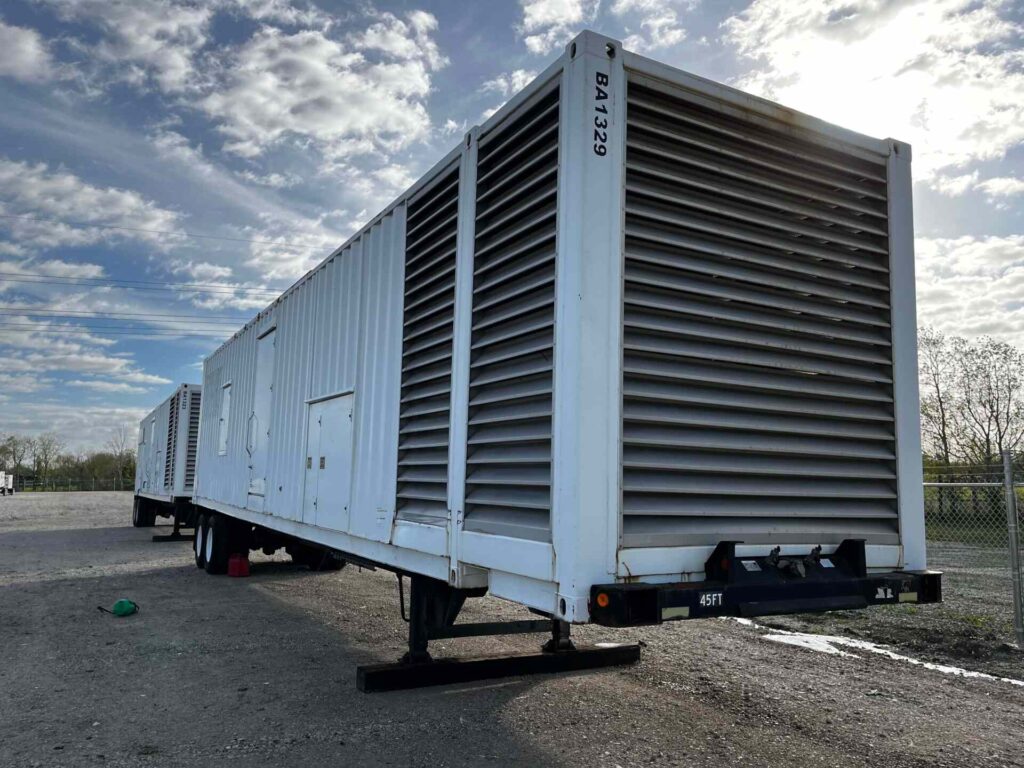
Across the Greater Houston area, electricity demand is often pushed to the limit in order to keep critical facilities online when heat indexes climb. When that strain is felt on the grid, voltage dips and power-quality issues can be triggered, so temporary power solutions are often positioned as added protection through industrial generators near Houston.
In many commercial and heavy industrial settings, a 2000 kW diesel generator rental is selected when peak load must be carried without downtime risk. These units are used as standby or prime assets, and switching and cabling are simplified when megawatt output is required under a clear industrial generator rental process.
Peak Demand Pressure Builds Across Houston Service Territory
Peak demand is not experienced as an abstract grid concept. It is felt as an operational constraint during afternoon and early-evening hours when air-conditioning loads rise and large facilities remain fully staffed. On the ERCOT grid, record peaks have been documented during summer heat events and published through ERCOT peak demand records.
Commercial sites in the Houston area have also been encouraged to shift or curtail demand during high-stress periods. Utility-led demand response and load management efforts have been promoted as tools that reduce strain on the system, including the CenterPoint Energy load management program.
When reducing energy load is not possible, temporary generation is often deployed as a more controllable option. Peak demand power solutions can be supported through staged equipment, including industrial generator rentals in Houston, so that loads are maintained while grid draw is reduced.
Why 2000 kW Capacity Gets Selected for Industrial Sites
A 2000 kW unit is usually not chosen because it is the biggest option for the job. Instead, it is chosen because the load profile has been evaluated, and a stable margin has been required. Large facilities in industrial power Houston environments are often built around motor loads, pumps, compressors, chillers, and process equipment. Inrush current, harmonic distortion, and step loading can be significant. If the generator is undersized, nuisance trips and voltage sag can be triggered during starts and transfers.
At the 2000 kW level, these common use cases tend to be seen:
- Planned shutdown support during electrical maintenance when utility power is intentionally isolated
- Backup coverage during storm season when outages are expected, and critical loads must remain served
- Peak shaving support when demand charges or operational penalties are being reduced
- Temporary capacity during expansions, commissioning, or equipment change-outs
Because output is delivered at industrial voltages, the distribution design of a generator becomes a primary driver for customers. Selection is often guided by real amperage requirements, which can be converted from kW with known voltage and power factor assumptions. A quick reference is available through an internal chart, such as amperage chart reference, which is commonly used when cable sizing and switchgear ratings are being checked.
How Diesel Rental Sets Support Peak Demand Power Solutions
Diesel generator packages are widely used as a temporary power solution because fast deployment is supported, and high torque response can be delivered. When peak demand events are anticipated, a diesel rental set can be staged ahead of time so that the site is kept protected during the highest-risk hours. Unlike smaller portable units, megawatt-class generators are built to accept heavy step loads when correct distribution and controls are provided.
Peak demand power solutions are typically implemented through one of these approaches:
- Standby coverage where the generator is started when utility service is lost, and critical loads are carried through an ATS or switching plan
- Planned parallel operation where load is shared with the utility to reduce grid draw during high-cost demand intervals
- Isolated prime operation where the site is powered independently during construction, commissioning, or extended maintenance
Demand charges and peak billing structures are commonly explained as being tied to the highest demand interval seen during a billing period. A plain-language overview can be reviewed through a federal reference, such as the USDA demand charge guidance. When a single short peak is capable of elevating a monthly demand charge, generator-supported load management can be viewed as a cost-control tool, not only an outage tool.
When a 2000 kW diesel generator rental is used as a peak support asset, attention is usually placed on transfer timing, step loading, and operator procedures. Clear load priorities are established so that critical processes are carried out first, and optional loads are brought on later.
Typical Temporary Power Architecture at 2000 kW Scale
A 2000 kW deployment is rarely treated as “just a generator.” A complete temporary electrical system is normally assembled so that power is distributed safely across the site. The following building blocks are commonly included:
- Generator set with digital controls, protective relays, and frequency and voltage regulation
- Temporary switchgear or distribution gear with metering and fault protection
- Cam-lock cable sets, feeder runs, and grounded connectors sized to the calculated current
- Transformers when voltage conversion is required
- Load bank testing when commissioning or verification is needed
Accessory components are typically treated as critical-path items because they govern safe installation and reliable load pickup. A centralized reference to temporary power add-ons can be used through a page, such as this one listing cables and accessories options.
When industrial power Houston sites are served, project planning is often centered on electrical one-lines, load schedules, and transfer points. Generator paralleling is sometimes used when redundancy is requested or when the load varies across stages. In those cases, synchronization, load sharing, and protective coordination are addressed during design so that fault current and selective tripping are managed.
| Common load category | Why 2000 kW is applied | Typical project trigger |
| Chillers and large HVAC | High inrush and steady kW draw are carried with a margin | Heat-driven peaks and building continuity needs |
| Process pumps and motors | Step loads are accepted when the distribution is sized correctly | Maintenance outages and production protection |
| Critical IT and controls | Stable frequency and voltage are maintained with proper switching | Redundancy requirements and uptime SLAs |
Permitting Safety and Compliance Signals in Texas
Temporary engines and generator sets in Texas can be subject to air permitting requirements depending on how they are classified and operated. A commonly cited framework is the Texas Commission on Environmental Quality guidance on portable and emergency engines, which can be reviewed online through this permitting site. The conditions that apply are influenced by run hours, emissions characteristics, and whether the unit is treated as emergency, standby, or non-emergency use.
Operational safety is also governed by electrical grounding and bonding requirements. When temporary distribution is installed, the neutral and equipment grounding conductor arrangements are required to be correct so that shock risk is reduced and protective devices operate as intended. OSHA has published a primer that can be referenced at osha.gov grounding requirements.
Life-safety facilities are often designed around emergency power standards. NFPA 110 is widely referenced in the U.S. when emergency and standby power system performance is being defined. An overview is available through NFPA 110 overview. Even when a project is not classified as life safety, the same disciplined approach to testing, maintenance, and transfer performance tends to be applied at the megawatt level.
Planning Steps that Reduce Risk and Cost on Peak Days
Better outcomes are usually produced when temporary power is planned early, especially during Houston peak seasons. The largest avoidable failures are often caused by missing distribution components, underestimated load steps, or rushed fuel logistics. A simple planning workflow is typically used:
- The load inventory is completed, and starting currents are identified so that step loading is anticipated
- Voltage selection is confirmed so that transformers and panels are matched to the site
- The run profile is defined so that the unit is permitted and fueled correctly
- The transfer method is chosen, such as ATS-based transfer or manual isolation with switchgear
- Commissioning is performed so that alarms, trip points, and load acceptance are verified
When the need is driven by a predictable storm window, contingency planning is often used so that equipment can be staged before logistics are constrained. A preparedness framework can be reviewed through an internal resource, such as this hurricane contingency plan resource.
When the project scope is being defined, an overview of temporary generator solutions can be referenced through pages such as industrial generators near Houston and industrial generator rental equipment details. Rental logistics and documentation expectations can also be clarified through resource pages describing how to rent an industrial generator.
When these steps are used, peak demand power solutions are more likely to be executed without last-minute redesign. The site is kept safer, and the probability of a transfer event turning into downtime is reduced.
Stag Power Rentals Support Across Greater Houston
Stag Power Rentals is positioned near the Gulf Coast and is focused on commercial and industrial generator rentals ranging from 20 kW through 2000 kW across Greater Houston and nearby communities. When a 2000 kW diesel generator rental is needed, equipment can be matched to the site so that generator capacity, cables, and accessories are aligned with the load plan. Stag offers:
- Coverage that is supported across Houston, Pasadena, Baytown, Sugar Land, Katy, The Woodlands, and Conroe through Houston industrial generator rentals
- Industrial fleet options that can be found on the following pages: industrial generators for rent and industrial generator equipment
- Power distribution add-ons are supported through cables and accessories
- Sector-specific planning supported across data centers, hospitals and healthcare, warehouse and manufacturing, construction, and commercial property, with additional coverage listed under industries served
When peak demand, outages, or maintenance disrupt industrial power in Houston operations, a quote request can be submitted so generator sizing, delivery, and accessories are aligned quickly. Call today for an estimate and to learn more about our services.
